


















For two years, whenever someone asked “which AI should I use?”, the answer was ChatGPT. It wasn’t even close. It was the default, the Kleenex of AI. But something changed in 2026. If you’re still paying OpenAI $20 a month on autopilot, you might be working with an outdated assumption. The benchmarks, developer surveys, and migration numbers tell a story that surprises most people — especially if you write, code, or do any kind of knowledge work for a living. In this comprehensive AI comparison, I’ll break down exactly where ChatGPT and Claude excel, where they fall short, and which one deserves your money.
Both tools are remarkable. Both are improving fast. But they were built with fundamentally different goals. Understanding that difference could save you a lot of frustration and money.
Quick Picks
Best Overall for Versatility & Features
ChatGPT Plus – The Swiss Army knife of AI. Image generation, voice mode, web browsing, deep research, and the widest ecosystem of integrations. $20/month.
Best for Writing, Reasoning & Coding
Claude Pro – The precision scalpel. Superior writing quality, deeper reasoning, larger context window, and the strongest coding agent in blind tests. $20/month ($17 annual).
Best Budget Option
ChatGPT Go – Ad-supported access to GPT-5.5 at just $8/month. Available in 98 countries.
Table of Contents
- How I Tested
- Scoring Criteria
- Comparison Table
- ChatGPT Review – The Versatile All-Rounder
- Claude Review – The Precision Powerhouse
- Head-to-Head: ChatGPT vs Claude
- Real Limitations I Observed
- FAQ
- Final Verdict
How I Tested
Testing Period: May–June 2026
I used both ChatGPT Plus and Claude Pro side by side for 30 days, running the same prompts and tasks across writing, coding, research, and everyday productivity. I evaluated:
- Writing quality: Naturalness, clarity, and engagement of outputs
- Reasoning depth: How well each handles complex, multi-step problems
- Coding ability: Code generation, debugging, and complexity handling
- Context window: How much text each can process and remember
- Feature set: Image generation, web browsing, voice, integrations
- Value for money: What you actually get for your subscription
Scoring Criteria
| Factor | Weight |
|---|---|
| Writing quality & naturalness | 25% |
| Reasoning & problem-solving | 20% |
| Coding capability | 20% |
| Feature breadth (image, voice, web) | 15% |
| Context window & memory | 10% |
| Value for money | 10% |
ChatGPT vs Claude: Comparison Table
| Feature | ChatGPT Plus | Claude Pro |
|---|---|---|
| Price | $20/month | $20/month ($17 annual) |
| Free Tier | ✅ 10 GPT-5.5 messages per 5 hours | ✅ Limited access |
| Flagship Model | GPT-5.5 | Claude Fable 5 |
| Context Window | 400,000 tokens | 1,000,000 tokens |
| Image Generation | ✅ DALL-E | ❌ None |
| Video Generation | ✅ Sora | ❌ None |
| Web Browsing | ✅ Real-time | ❌ None |
| Voice Mode | ✅ Low latency | ✅ Basic |
| Coding Agent | ✅ Codex | ✅ Claude Code (terminal) |
| Custom GPTs | ✅ Yes | ❌ No |
| Best For | Versatility, research, creative work | Writing, coding, long documents |
*Prices and features can change. Check official websites for current plans.
ChatGPT Review – The Versatile All-Rounder
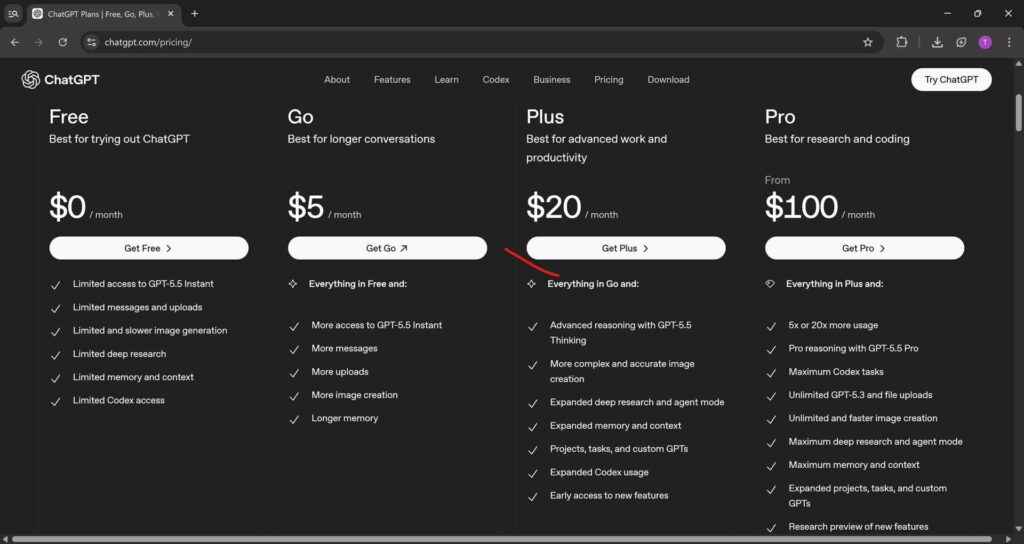
What I Found
ChatGPT is OpenAI’s conversational AI, first launched in 2022. Built on a series of increasingly powerful large language models (from GPT-3.5 through to GPT-5.5), it quickly became one of the most widely adopted AI assistants in history. Its biggest strength is breadth. ChatGPT can generate images via DALL-E, browse the web in real time, hold voice conversations with remarkably low latency, and connect to thousands of third-party tools.
In my testing, ChatGPT’s Deep Research was exceptionally accurate, supplying links to information sources that I could verify if needed. The versatility is unmatched — I used it for everything from drafting marketing emails to brainstorming blog topics to debugging code. It’s the one AI you can use for almost any task.
What I Liked
- Unmatched versatility: Handles writing, coding, brainstorming, tutoring, and more
- Multimodal capabilities: Processes and generates text, images, and audio
- Massive ecosystem: Custom GPTs, plugins, and deep integrations
- Generous free tier: 10 GPT-5.5 messages every 5 hours
- Deep Research: Exceptionally accurate with verifiable sources
What I Didn’t Like
- Can generate incorrect information confidently (hallucinations)
- Writing can feel verbose and generic without careful prompting
- Prone to telling users what they want to hear rather than what is accurate
- Smaller context window than Claude (400,000 tokens vs 1,000,000)
Who Should Use ChatGPT
- General users who need one AI that does a bit of everything
- Content creators who need image generation alongside writing
- Researchers who need real-time web browsing and Deep Research
- Teams who want custom GPTs and a wide integration ecosystem
Verdict
ChatGPT is the best AI comparison pick for anyone who needs a versatile, feature-rich assistant. It’s the Swiss Army knife of AI — not always the best at any single task, but capable of handling almost anything you throw at it.
Score: 9.1/10
Claude Review – The Precision Powerhouse
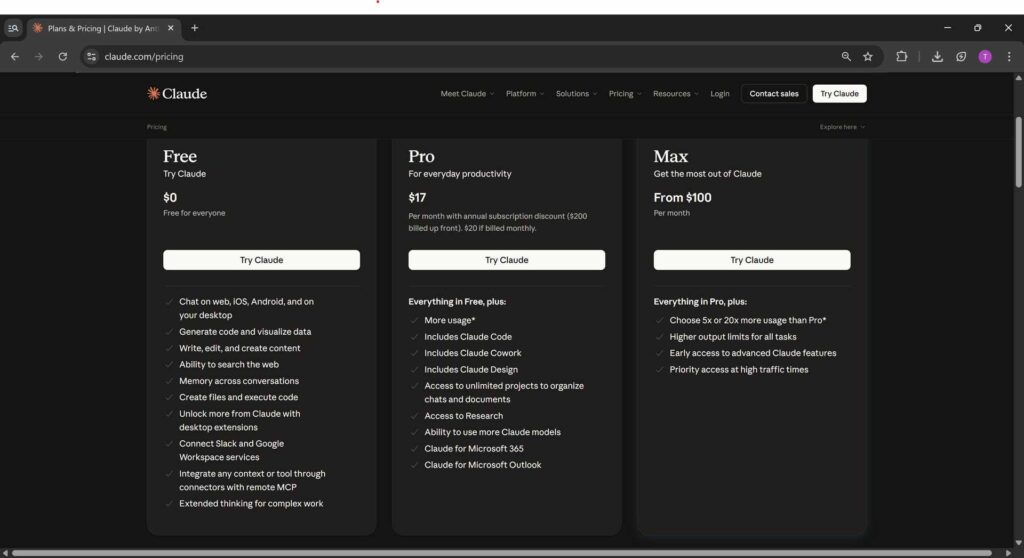
What I Found
Claude is Anthropic’s conversational assistant, first launched in 2023 and built with a strong emphasis on safety, honesty, and reliability. Its architecture is grounded in what Anthropic calls “Constitutional AI” — a framework that trains the model against guiding principles designed to make outputs helpful, honest, and resistant to harmful or biased content.
Where ChatGPT bets on breadth, Claude bets on depth. It is particularly strong at writing, reasoning, coding, and handling large volumes of text — and it’s specifically designed to push back when you’re wrong rather than simply agree with you. In my testing, Claude’s writing felt more natural and less generic than ChatGPT’s. It also flagged uncertainty rather than guessing confidently, which I appreciated for research-heavy tasks.
What I Liked
- Exceptional reasoning: Excels at complex multi-step problems
- Larger context window: 1,000,000 tokens — roughly 150,000 words
- Cleaner, more natural writing: Fewer filler phrases
- More likely to flag uncertainty: Won’t guess confidently when unsure
- Preferred by 70% of developers for coding tasks
What I Didn’t Like
- Cannot generate images — no DALL-E equivalent
- No real-time web browsing — limited to knowledge cutoff
- Voice mode is less polished than ChatGPT’s
- Tight usage limits: A single complex Claude Code session can consume 50-70% of your five-hour quota
- Can be overly cautious with creative or hypothetical prompts
Who Should Use Claude
- Writers who need natural, polished prose with deep reasoning
- Developers working on complex, multi-step coding tasks
- Researchers handling long documents and large volumes of text
- Compliance-focused teams who value accuracy over agreeableness
Verdict
Claude is the best AI comparison pick for anyone who needs depth over breadth. It’s the precision scalpel — not as versatile as ChatGPT, but superior at writing, reasoning, and complex coding.
Score: 9.3/10
Head-to-Head: ChatGPT vs Claude
Writing Quality
Winner: Claude
Claude’s writing is cleaner, more natural, and less filler-heavy. It also flags uncertainty rather than guessing confidently. ChatGPT can produce great writing, but it often needs more specific prompting to avoid sounding generic.
Coding Ability
Winner: Claude
Claude leads the published coding benchmarks and bundles a terminal coding agent (Claude Code) at no extra cost. In blind coding tests, Claude Code outperforms ChatGPT’s Codex. Claude is better at handling long, complex code, while ChatGPT is faster at small coding tasks and quick fixes.
Reasoning & Accuracy
Winner: Claude
Claude excels at deep reasoning and large context tasks. It pushes back when you’re wrong rather than simply agreeing with you. ChatGPT can produce confident but incorrect answers.
Context Window
Winner: Claude
Claude’s 1,000,000 token context window dwarfs ChatGPT’s 400,000. This makes Claude significantly better at processing and remembering long documents, codebases, and conversations.
Feature Breadth
Winner: ChatGPT
ChatGPT wins hands-down on features: image generation (DALL-E), video generation (Sora), real-time web browsing, voice mode, custom GPTs, and a massive integration ecosystem. Claude offers none of these.
Pricing & Value
Winner: Tie
Both ChatGPT Plus and Claude Pro cost $20/month. ChatGPT offers more messages and features. Claude offers superior quality for writing and coding. ChatGPT Go at $8/month is the cheapest paid option for budget-conscious users.
Real Limitations I Observed
ChatGPT
ChatGPT’s writing can feel generic without detailed prompts. I found myself spending extra time tweaking prompts to get the tone I wanted. The context window is smaller than Claude’s, so long conversations or documents often required me to repeat information. It also occasionally hallucinated facts with high confidence, which meant I had to double-check important outputs.
Claude
Claude’s usage limits are tight — a single complex coding session can consume 50-70% of your five-hour quota. This is a major frustration for power users. It also lacks image generation, web browsing, and voice features. The model can be overly cautious with creative or hypothetical prompts, sometimes refusing to engage with perfectly reasonable questions.
FAQ
Is Claude better than ChatGPT in 2026?
Neither is universally better. Claude is better at writing, coding, reasoning, and handling long documents. ChatGPT is better for versatility, image generation, web browsing, and everyday tasks. The gap is narrowing with every release, and the best choice depends on your specific needs.
Which AI is better for coding, ChatGPT or Claude?
Claude is better for complex, multi-step coding tasks and long codebases. It leads coding benchmarks and bundles Claude Code at no extra cost. ChatGPT is faster for small coding tasks and quick fixes. In blind coding tests, Claude Code outperforms ChatGPT’s Codex. Claude is also preferred by 70% of developers for coding tasks.
Which AI writes better, ChatGPT or Claude?
Claude writes better for most professional use cases. Its outputs are cleaner, more natural, and less filler-heavy. Claude’s writing also flags uncertainty rather than guessing confidently ChatGPT can produce great writing, but it often sounds generic without careful prompting.
What is the main difference between ChatGPT and Claude?
The main difference is breadth vs depth. ChatGPT is built for versatility — it does a bit of everything with a wide feature set including image generation, web browsing, and voice. Claude is built for depth — it excels at writing, reasoning, coding, and handling long documents. ChatGPT is the Swiss Army knife; Claude is the precision scalpel.
Is it worth paying for both ChatGPT and Claude?
For many power users, yes. Both ChatGPT Plus and Claude Pro cost $20/month each. By 2026, most power users will be paying for both. One provides versatility and features; the other provides depth and quality. If your work involves both creative content and complex coding, the $40/month combined cost is often justified.
Does Claude have a free tier?
Yes. Claude offers a free tier with limited access to Claude Sonnet 4.6. For heavier usage, Claude Pro costs $20/month ($17 with annual billing). The free tier is compute-based and will switch to smaller models after usage limits are reached.
Final Verdict: Which AI Should You Choose in 2026?
Here’s my honest take after 30 days of side-by-side testing:
Choose ChatGPT if: You need a versatile all-rounder. You want image generation, web browsing, voice mode, and a wide ecosystem of integrations. You’re a content creator, marketer, or general user who needs one AI that does a bit of everything. ChatGPT is the best AI comparison pick for versatility and feature breadth.
Choose Claude if: You prioritize depth over breadth. You write professionally, code complex applications, or handle long documents. You value accuracy and natural writing over features. Claude is the best AI comparison pick for writing quality, coding, and reasoning.
Use both if: You have the budget. Many power users subscribe to both — ChatGPT for versatility and Claude for depth. For a combined $40/month, you get the best of both worlds: ChatGPT’s features and Claude’s quality.
For more AI comparisons and tool guides, check out our ChatGPT vs Google Gemini comparison. If you’re building AI-powered workflows, our guide to best AI tools to automate workflow in 2026 covers how to integrate both platforms into your stack.
For more honest tech reviews and tested buying guides, visit QalTech.com.